Dramaturgy Reflection | JULIUS CAESAR
by Bee LaClair
“Any work by Shakespeare is a dramaturgically heavy lift not only for those producing it but also for audience members. It is no secret that the language is challenging and even, at times, seemingly impossible. Throw into the mix a historical (however contemporary it may seem) event and you have a show that requires total focus from your audience. For that reason, I believe that drawing the audience in and engaging them in the production from the moment they step into the building will be incredibly important.”
— First Pitch of this Project to Emerson Stage
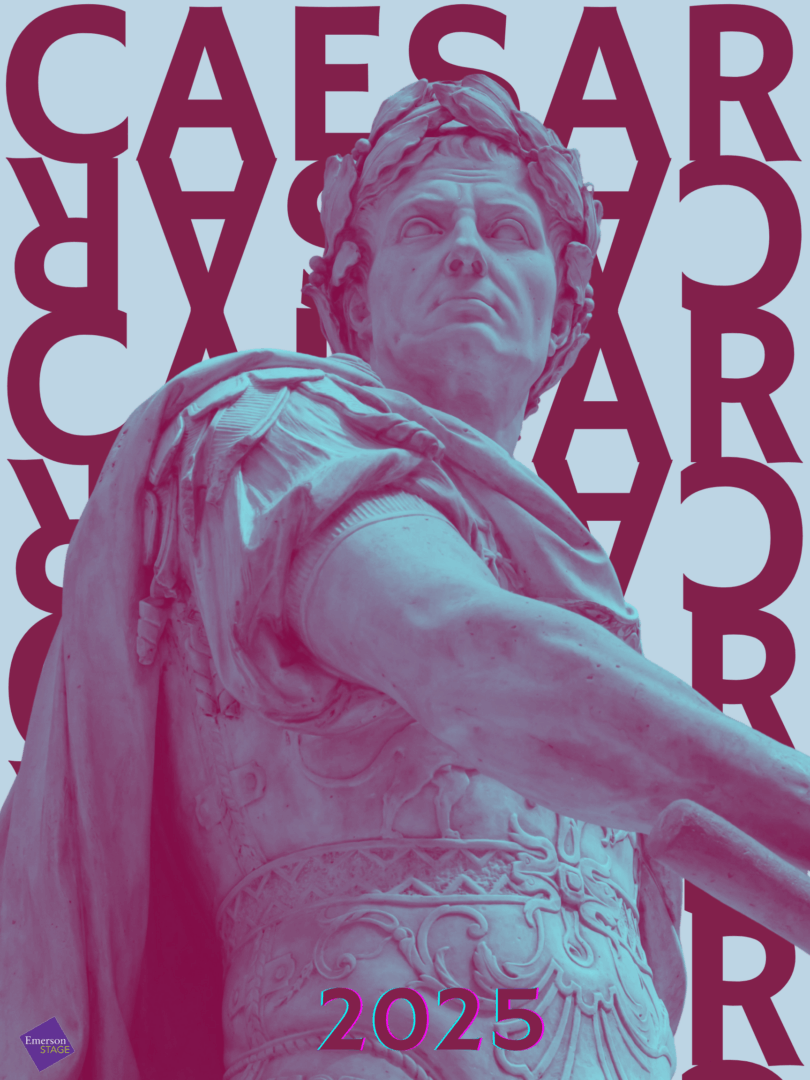
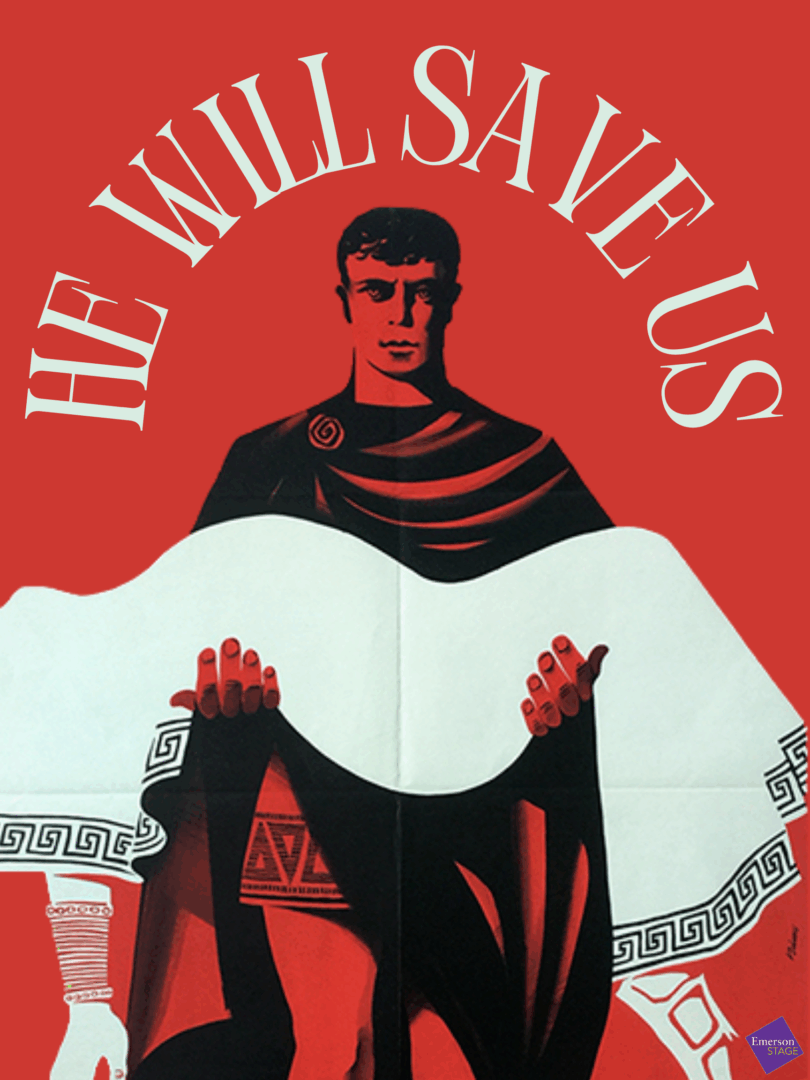
Above: a pro-Caesar poster featured in the lobby. Some were “vandalized” with graffiti.
When I began my dramaturgy work on this project I knew that I wanted to challenge myself. Inspired by my interdisciplinary studies major, I decided that I wanted to create an immersive pre-show dramaturgical experience—a mouthful, but an exciting one. I could never have done this alone, so I was thrilled to add Nina Turovskiy, the Assistant Director, to my team. A huge thank you to you, Nina, for all of your hard work—and to everyone who believed in us!
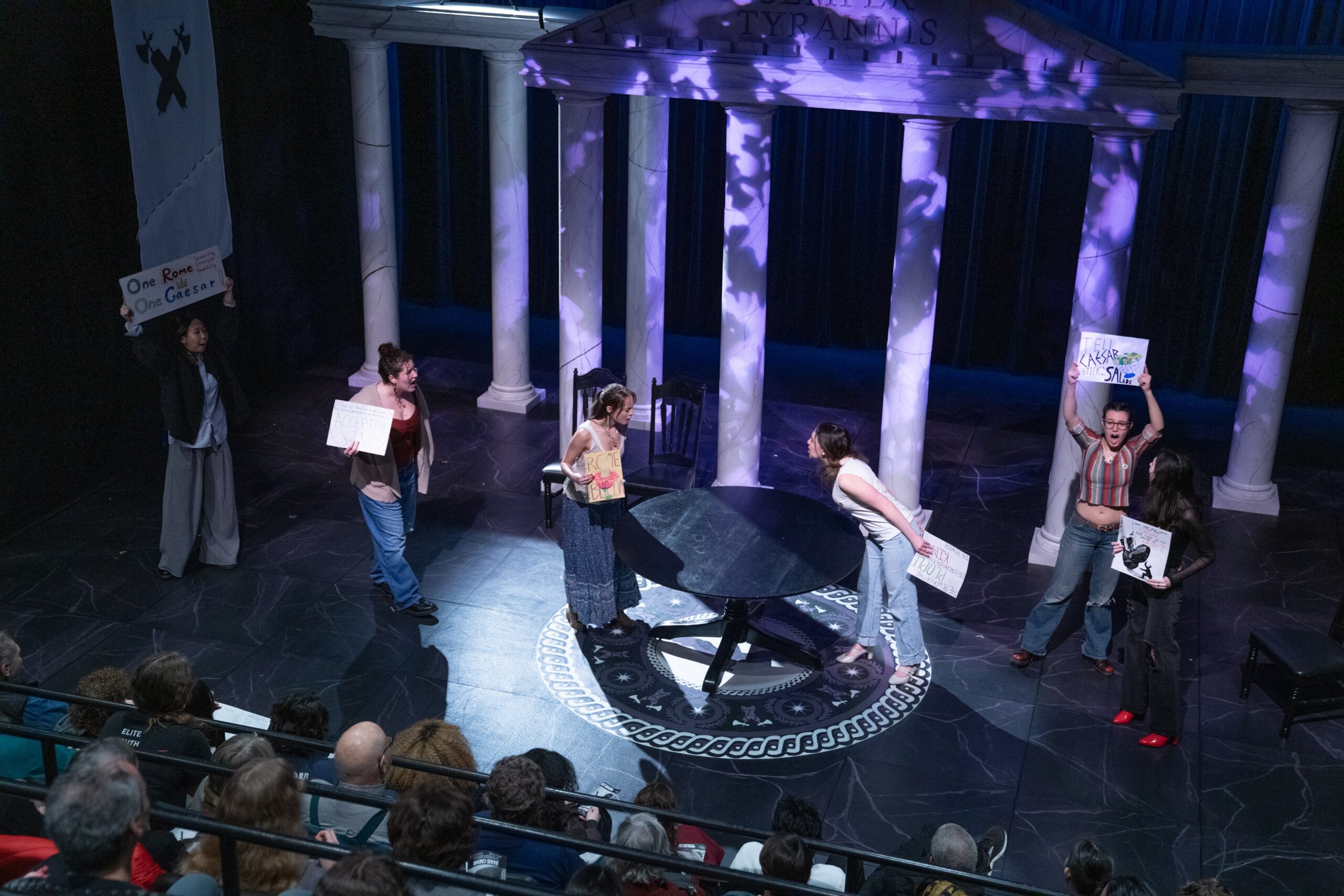
We created this immersive pre-show dramaturgical experience with one goal in mind: to prime the audience with bias before the show. The idea was to have the understudies interact with audience members (and each other!) to argue for or against the crowning of Caesar. We worked with our team of understudies to create talking points, arguments, questions, and ideas that they could share with the audience as they came into the lobby of the theatre.
Arguing against a king wasn’t hard. We have plenty of rhetoric to pull from in our own contemporary politics. More challenging was arguing for Caesar, and I have to credit our understudies for working together to create an argument that could be compelling to our audience. We decided that, for our Pro-Caesar group, Caesar represented stability, strength, and peace. He was the epitome of a Roman, the greatest to have ever lived—why not give such a mighty man the crown? He would protect Rome, after all. Still, this wasn’t enough. It was clear to us that our Anti-Caesar group had to take their arguments further, engage in some of the uncomfortable extremism that polarizes political parties. We pushed the Anti-Caesar group towards violence and blind hatred, while the Pro-Caesar group took a more compassionate route. They argued that Caesar was no more ambitious than any other senator, and that senseless violence is what led Rome to such unrest in the first place.
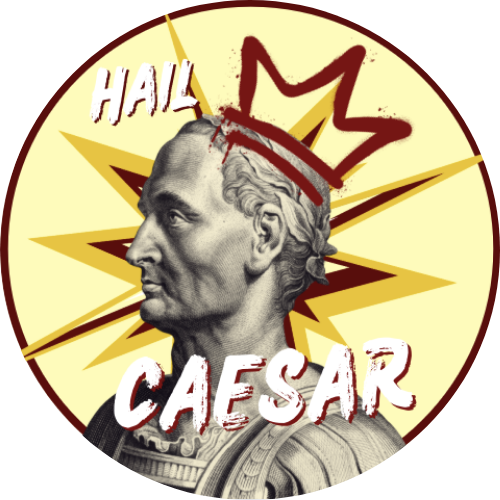
Above: a pin worn right-side-up by pro-Caesar advocates and upside-down by anti-Caesar advocates
Whether the audience came into this knowing anything about the Roman Empire or not, before they took their seats they had some idea of whose side they were on. They were even asked to physically display that choice by wearing a “Hail Caesar!” pin either right-side-up or upside-down. By the end of the performance, I hope the audience investigated their own biases and how they may have changed—or been affirmed—by the performance. Did they think Caesar deserved the crown? Did the idea of a republic-turned-monarchy scare them? Did watching Caesar’s brutal murder change their mind? Or did it satisfy them to see him die?
If you saw the show, ask yourself: Were you right? Were you wrong? Did you trust yourself to choose in the first place? Was it uncomfortable to pick a side? Or were you wholeheartedly convinced?
Ultimately, I hope that this experience helped audience members to situate themselves in the world that our creative team, company and crew worked so hard to create. If one person surprised themself with their own biases, I will consider it a wild success! To you, reader: the world we live in can be terrifying. It is constantly changing, it is unprecedented, and it is ours. Educating ourselves is the first step to checking our biases and expanding our worldviews. Practice mindfulness, practice patience, practice empathy. Our power lies in our boots on the ground, our words, and our kindness. Take a second to see from someone else’s eyes today. You might be surprised by what you see!